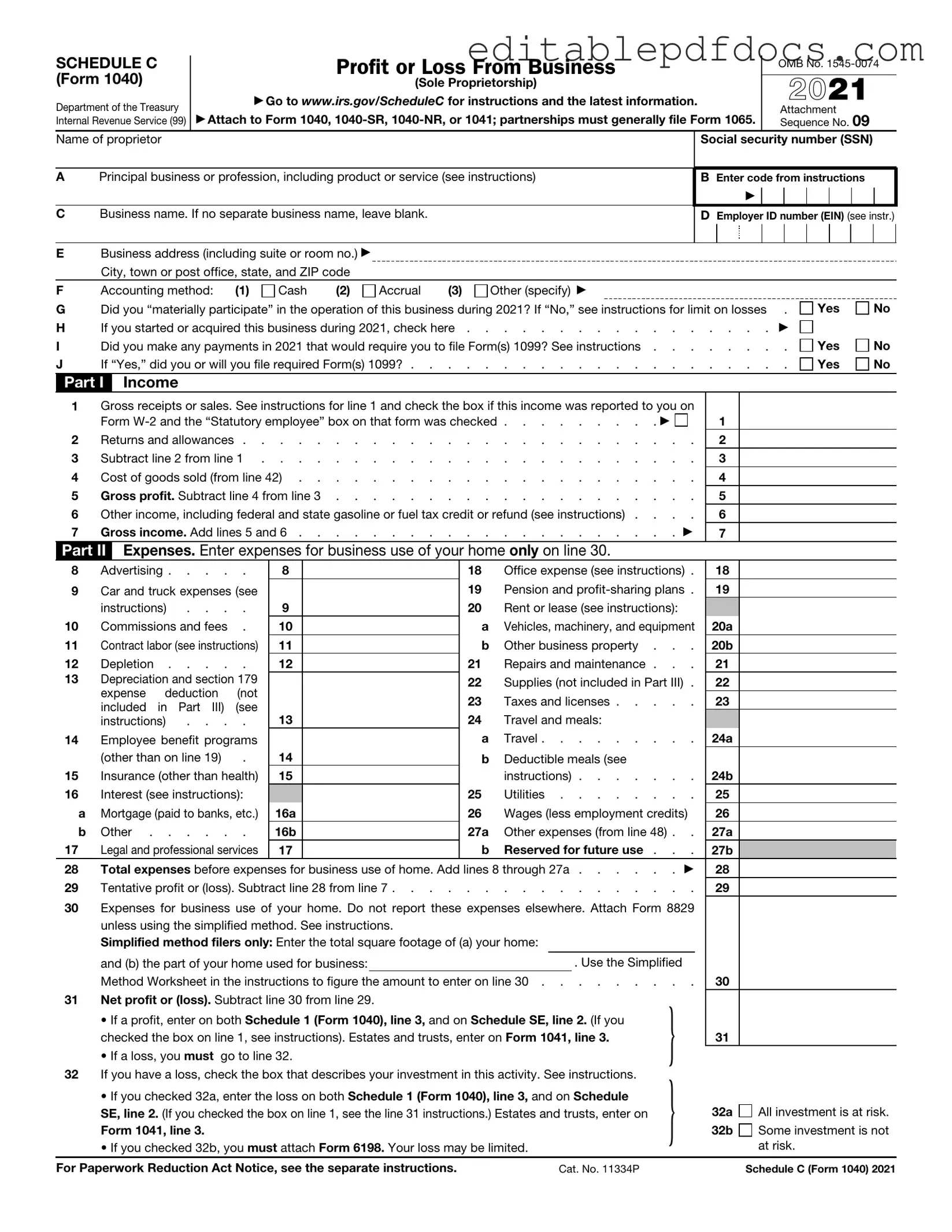
Fill a Valid IRS Schedule C 1040 Template
The IRS Schedule C (Form 1040) is a crucial document for self-employed individuals and sole proprietors, serving as a detailed report of income and expenses related to their business activities. This form allows taxpayers to declare their earnings, providing a comprehensive overview of revenue generated throughout the year. It also offers the opportunity to deduct various business-related expenses, such as costs for supplies, utilities, and travel, which can significantly lower taxable income. Additionally, Schedule C requires individuals to categorize their business activities, ensuring accurate reporting and compliance with tax regulations. Understanding the nuances of this form is essential, as it impacts not only tax liability but also eligibility for certain credits and deductions. Navigating the complexities of the Schedule C can be challenging, yet it is a vital step in maintaining financial transparency and fulfilling obligations to the IRS.
Document Details
| Fact Name | Description |
|---|---|
| Purpose | The IRS Schedule C (Form 1040) is used by sole proprietors to report income and expenses from a business. |
| Filing Requirement | Taxpayers must file Schedule C if they have a net profit from their business activities. |
| Business Income | All income from the business must be reported, including cash, checks, and credit card payments. |
| Deductible Expenses | Common deductible expenses include supplies, utilities, and business-related travel costs. |
| Net Profit or Loss | The form calculates the net profit or loss by subtracting total expenses from total income. |
| Self-Employment Tax | Net profit from Schedule C is subject to self-employment tax, which funds Social Security and Medicare. |
| Record Keeping | Taxpayers should maintain accurate records of income and expenses to support their Schedule C filings. |
| State-Specific Forms | Some states require additional forms or have specific laws governing business income reporting. |
Dos and Don'ts
When filling out the IRS Schedule C (Form 1040), it's important to approach the process with care to ensure accuracy and compliance. Here are five things you should and shouldn't do:
- Do: Gather all necessary documents before you start. This includes income statements, receipts for expenses, and any other relevant financial records.
- Do: Clearly report all income earned from your business. Be thorough to avoid underreporting, which can lead to penalties.
- Do: Keep detailed records of your business expenses. This will help you maximize your deductions and provide proof if needed.
- Do: Use the correct accounting method. Choose between cash or accrual accounting, and be consistent in your approach.
- Do: Review your completed form for errors before submission. Double-checking can save you from costly mistakes.
- Don't: Leave any fields blank. If a section does not apply to you, write “N/A” instead of skipping it entirely.
- Don't: Inflate your expenses. Only claim legitimate business expenses to avoid issues with the IRS.
- Don't: Forget to sign and date your form. An unsigned form is considered incomplete.
- Don't: Submit your Schedule C without supporting documents if you are audited. Keep your records organized and accessible.
- Don't: Rely solely on estimates for income and expenses. Accurate figures are essential for a successful filing.
Documents used along the form
When filing your taxes as a self-employed individual or a small business owner, the IRS Schedule C (Form 1040) is crucial. However, it is often accompanied by several other forms and documents that can help provide a complete picture of your financial situation. Below is a list of common forms and documents that you may need to consider when preparing your tax return.
- Form 1040: This is the standard individual income tax return form. It summarizes your overall income, deductions, and tax liability.
- Schedule SE: This form is used to calculate self-employment tax. If you earn more than a certain amount from self-employment, you must file this to determine your tax obligations.
- Form 4562: This form is necessary for claiming depreciation on your business assets. It helps you spread the cost of an asset over its useful life.
- Form 8829: If you use part of your home for business, this form allows you to deduct expenses related to that home office space.
- Form 1099-MISC: This document reports income earned from clients or other sources. If you received payments of $600 or more from a client, they should provide you with this form.
- Form W-2: If you have a part-time job in addition to your self-employment, this form reports your wages and the taxes withheld by your employer.
- Receipts and Invoices: Keeping detailed records of your business expenses is essential. Receipts and invoices serve as proof of your expenses and can help substantiate your deductions.
- Bank Statements: These documents can help verify income and expenses. They provide a clear record of your financial transactions throughout the year.
- Previous Year’s Tax Return: Reviewing your last year's return can provide useful insights and ensure consistency in your reporting.
Gathering these documents and forms can seem daunting, but they play a vital role in accurately reporting your income and expenses. By ensuring you have everything in order, you can make the tax filing process smoother and less stressful.
Popular PDF Forms
How to Fill Out Pdf on Phone - The form will ask for your desired position and salary expectations, helping employers understand your goals.
The USCIS I-864 form, also known as the Affidavit of Support, is a legally binding document that ensures an immigrant's financial support in the United States. By signing this form, sponsors commit to providing financial assistance if the immigrant cannot support themselves. This obligation is vital for ensuring that new arrivals can thrive and integrate into American society. For more information and resources, you can refer to the Templates and Guide.
Test Drive Form - The form serves as a record for the dealership’s office use only.
Similar forms
- IRS Form 1065: This form is used by partnerships to report income, deductions, gains, and losses. Like Schedule C, it provides a detailed account of business operations, but it is specifically for entities with multiple owners.
- IRS Form 1120: Corporations use this form to report their income and pay corporate taxes. Both Schedule C and Form 1120 require detailed financial information, but Form 1120 is for corporations rather than sole proprietorships.
- IRS Form 1120S: This is the tax return for S Corporations. Similar to Schedule C, it allows for pass-through taxation, where income is reported on the owners' personal tax returns.
- IRS Form Schedule E: Used to report income or loss from rental real estate, partnerships, and S corporations. Schedule E shares similarities with Schedule C in that both forms require reporting of income and expenses, but they focus on different types of income.
- IRS Form 1040: The standard individual income tax return form. Schedule C is an attachment to Form 1040 for sole proprietors, allowing them to report business income directly on their personal tax return.
- IRS Form 4562: This form is used to claim depreciation and amortization. While Schedule C reports income and expenses, Form 4562 specifically addresses asset depreciation, which can affect the overall business income reported on Schedule C.
- IRS Form 8829: This form is for claiming expenses for business use of your home. It is similar to Schedule C in that it allows for the reporting of business-related expenses, but it focuses specifically on home office deductions.
- IRS Form 1040 Schedule F: This form is used by farmers to report income and expenses. Like Schedule C, it requires detailed reporting of income and expenses, tailored specifically for agricultural operations.
- IRS Form 1099-MISC: This form is used to report miscellaneous income, including payments made to independent contractors. While not a tax return, it is related to income reporting similar to what is done on Schedule C.
Common mistakes
When filling out the IRS Schedule C (Form 1040), many individuals make common mistakes that can lead to complications down the line. One prevalent error is failing to report all income. Business owners often overlook additional income sources, such as cash payments or side gigs. Every dollar counts, and the IRS expects a complete account of earnings to ensure accurate tax calculations.
Another frequent misstep involves misclassifying expenses. Some individuals may incorrectly categorize personal expenses as business expenses, which can raise red flags during an audit. It’s essential to differentiate between personal and business costs clearly. For example, a home office deduction should only apply to the portion of the home used exclusively for business purposes.
Many taxpayers also neglect to keep proper records. Inadequate documentation can lead to difficulties in substantiating claims. Receipts, invoices, and bank statements serve as vital proof of income and expenses. Without these records, it becomes challenging to defend deductions if the IRS questions them.
Additionally, some people underestimate their self-employment tax liability. Self-employed individuals must pay both the employee and employer portions of Social Security and Medicare taxes. This can significantly impact overall tax liability, and failing to account for it can lead to unexpected tax bills.
Another common error is using the wrong method for calculating net profit or loss. The IRS allows for either the cash or accrual accounting method, and selecting the wrong one can distort financial reporting. Understanding which method best reflects the business's financial situation is crucial for accurate reporting.
Many filers also forget to sign and date the form. A Schedule C that lacks a signature is considered incomplete and can delay processing. This simple oversight can lead to unnecessary complications or even penalties.
Finally, some individuals fail to seek professional help when needed. The tax code can be complex, and navigating it alone may lead to mistakes. Consulting a tax professional can provide clarity and ensure that all aspects of the Schedule C are completed correctly, ultimately saving time and money.